

Bali Temple Dress Code: What to Wear, Sarongs and the Rules
To enter a Balinese temple you need a sarong round your legs, a sash at your waist and covered shoulders. Most big temples include them in the ticket or lend them for a donation. Since 2025 the basics are also official rules for foreign visitors, set out in a Governor’s circular.
By Aleks & Ria Facts checked 29 November 2026 6 min read
- Must wear
- Sarong and sash, covered shoulders
- Lent at
- Most big temples, often included
- Buy one
- About IDR 50,000 to 150,000
- Official rules
- Governor’s Circular 7 of 2025
Some links are partner links: if you book through them we may earn a commission at no cost to you. Partners never choose what we recommend.
Bali has tens of thousands of temples (pura), from family shrines to the great state temples, and they are places of worship first. The dress rule is simple and the same everywhere: cover your legs with a sarong, tie a sash round your waist, and cover your shoulders. It applies to men and women, children included.
In March 2025 the Governor of Bali turned the basics into official rules for foreign visitors in Circular No. 7 of 2025 on tourist conduct. Visitors must dress modestly at sacred places, tourist sites and in public, must not enter the inner courtyards of a temple unless they are praying in Balinese dress, and must not enter if menstruating. Breaking the rules can lead to sanctions.
Plan this trip
Partner links. Prices are approximate.
What to wear to a Bali temple
-
Sarong (kamen or kain)
- What it is
- A length of cloth wrapped round the waist to the ankles
- Who wears it
- Everyone
- Where to get it
- Lent at most temples; buy one for about IDR 50,000 to 150,000
-
Sash (selendang or senteng)
- What it is
- A narrow band tied round the waist over the sarong
- Who wears it
- Everyone
- Where to get it
- Lent with the sarong
-
Top
- What it is
- A shirt or blouse covering the shoulders and upper arms
- Who wears it
- Everyone
- Where to get it
- Your own; a scarf over a strappy top will do
-
Udeng
- What it is
- The white or patterned Balinese head cloth
- Who wears it
- Men, optional for visitors
- Where to get it
- Markets and souvenir shops
-
Kebaya
- What it is
- A fitted lace blouse worn with sarong and sash
- Who wears it
- Balinese women for prayer, optional for visitors
- Where to get it
- Markets and tailors
For most temple visits, a sarong, a sash and a T-shirt are all you need.
How to tie a sarong
- Hold the sarong behind you at waist height, the long side horizontal.
- Men: wrap it round so the ends meet at the front, fold the extra cloth into a pleat in the middle and roll the top down to hold it. Balinese men often leave a front corner hanging to the ground.
- Women: wrap it round from right to left so it overlaps on one side, then tuck the end in at the waist.
- Tie the sash firmly round your waist over the top of the sarong, with a simple knot or bow at the front or side. The sash matters: it symbolises keeping your thoughts in balance, and some temple guards will stop you without one.
A sarong should reach your ankles, or at least well below the knee. Shorts under it are fine.
Women, men and children
- Women: shoulders and upper arms covered, no low necklines or see-through tops. Long hair is best tied back. You do not need a kebaya or a headscarf.
- Men: shirts on, including on hot days and at beach temples. A T-shirt is fine; a collared shirt is more respectful for ceremonies.
- Children: the same rules, with child-size sarongs lent at the larger temples.
- Shoes: keep them on in the outer courtyards unless asked to remove them; take them off where locals do.
Which temples lend sarongs
At the temples on most itineraries a sarong and sash are lent at the gate, included in the ticket or for a small donation. At village temples there may be nobody to lend you one, so if you plan to wander, carry your own. A light sarong also works as a beach cover-up, a shawl in the highlands and a blanket on night buses.
Sarongs at the main temples
-
Uluwatu
Google Maps(opens in a new tab)- Sarong
- Lent free with the ticket
- Good to know
- Hold on to sunglasses and phones because of the monkeys
-
Tirta Empul
Google Maps(opens in a new tab)- Sarong
- Lent with the ticket
- Good to know
- Bathing in the pools needs a separate sarong, rented on site
-
Besakih
Google Maps(opens in a new tab)- Sarong
- Included with the guide and shuttle
- Good to know
- Inner courtyards are for worshippers
-
Lempuyang
Google Maps(opens in a new tab)- Sarong
- Included with the shuttle ticket
- Good to know
- The gate photo queue is long
-
Goa Gajah
Google Maps(opens in a new tab)- Sarong
- Lent with the ticket
- Good to know
- Steps down to the cave
-
Tanah Lot
Google Maps(opens in a new tab)- Sarong
- Not needed for the grounds
- Good to know
- Visitors cannot enter the temple on the rock
-
Ulun Danu Beratan
Google Maps(opens in a new tab)- Sarong
- Not needed for the gardens
- Good to know
- The shrines are fenced off from visitors
Practice changes; bring your own sarong if you want to be sure. Our [temples guide](/best-temples-in-bali/) has current entry fees.
Temple behaviour
- Do not climb on shrines, walls, statues or sacred trees, and never sit higher than a priest or people praying.
- Do not walk in front of people praying, and keep your voice down.
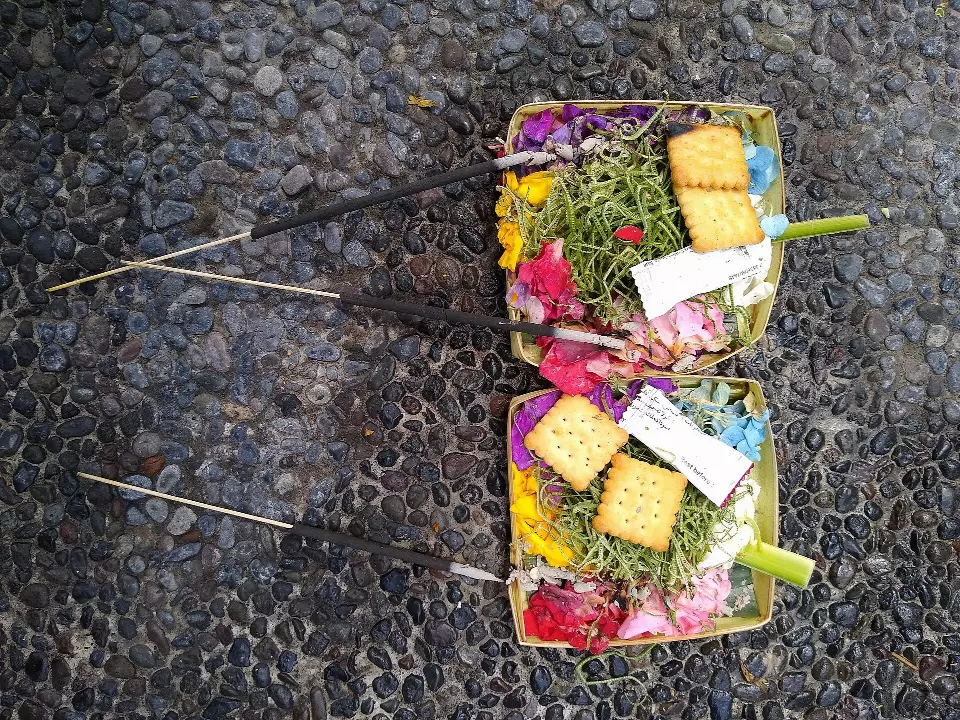
- Do not step on offerings (canang) on the ground. If one is in your way, step round it.
- Inner courtyards (utama mandala) are for prayer. Even with a sarong, stay out unless you are invited to pray.
- Photos: fine in most outer areas, but ask before photographing people, never use flash during a ceremony, and do not pose on shrines or in revealing clothes. Disrespectful photos have led to deportations.
- Drones need permission from the temple.
- Ceremonies: if one is happening, you may be asked to stay outside. It is still a wonderful sight from the edge.
Our Bali etiquette guide and Balinese culture and religion guide explain the reasons behind these customs.
Dress outside temples
The 2025 circular also asks visitors to dress modestly in public places, not only temples. In practice, swimwear is fine on the beach and by the pool, but put on a top and shorts or a sarong before walking into shops, cafes, markets and villages. Going topless or nude on the beach is not acceptable in Bali, and Indonesia’s new criminal code covers public indecency; see our criminal code guide.
Where to buy a sarong
Any market or souvenir shop sells them. Simple rayon sarongs cost about IDR 50,000 to 100,000 after bargaining, batik or endek cloth more. Sashes cost about IDR 20,000 to 50,000. Good places are Ubud market, Sukawati and Denpasar’s Kumbasari. A sarong is also one of the most useful souvenirs to take home.
Temple day checklist
Your ticks are saved on this device.
Wear
Bring
Remember
Read next: the best temples in Bali, Tirta Empul purification and Bali etiquette rules.
Temple dress code questions
What should I wear to a temple in Bali?
A sarong covering your legs, a sash tied at your waist, and a top that covers your shoulders. Men and women follow the same rule.
Do I need to bring my own sarong?
Not for the big temples, which lend one with the ticket or for a small donation. For village temples, bring your own.
Can I wear shorts to a temple in Bali?
Only under a sarong. Shorts alone, even long ones, are not enough inside a temple.
Can women visit Bali temples during their period?
Balinese custom asks women who are menstruating not to enter, and the Governor’s 2025 circular includes this rule. You can still look from outside the gate.
Can tourists enter the inner part of a temple?
No, the inner courtyards are for prayer. Under the 2025 rules, visitors may only enter them to pray, in Balinese dress.
How much does a sarong cost in Bali?
About IDR 50,000 to 100,000 for a simple one at a market, more for batik or endek cloth.
Ready to book?
The usual order: flights, first nights, airport pickup, insurance, data.
Partner links. Prices are approximate.
Official sources
- Bali Provincial Tourism Office: Governor’s rules for tourists(opens in a new tab)
- Bali Provincial Tourism Office(opens in a new tab)
- Indonesia Travel(opens in a new tab)
Updated

Aleks & Ria
Authors of ogo!bali
Built by an expat and an Indonesian local, ogo!bali delivers clear, fresh advice from both sides of the island. We blend local insider secrets with practical travel tips to help you explore with confidence.